
Burano is the wonderful island in the Venice lagoon famous for its colorful little houses reflected in the water, but that’s not all!
There is a magical thread that runs through the whole history of Burano and it is the one that is woven to create the wonderful lace, the typical handicraft of the place!
A true art that amazes millions of visitors every year: did you know that you can buy handmade lace?
If you choose to visit the lace museum you can also see the master lace makers at work after learning about the history of Buranello lace.
What are you waiting for? Book your visit to secure priority admission to the museum and see this wonderful art with your own eyes!
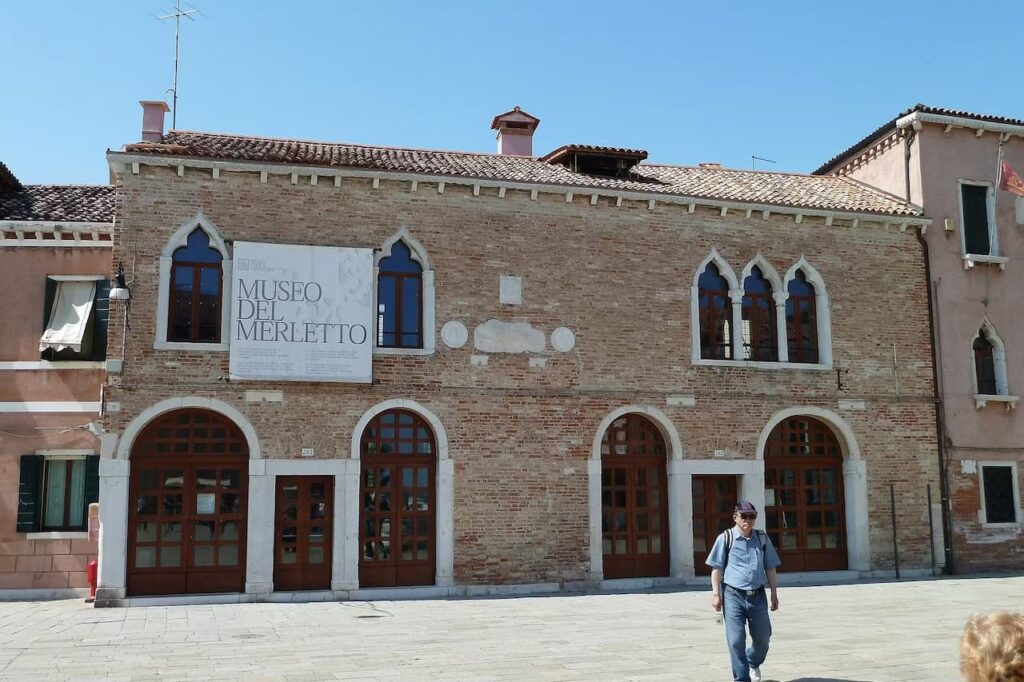
Lace Museum: Entrance Ticket
Discover the history and art of Venetian lace
Secure payment
Instant confirmation
Mobile ticket
The history of buranello lace
Buranello lace is among the most appreciated lace in the world and has very ancient origins: there is also no shortage of legends related to the development of this precious craft!
Probably, this typical ability of the inhabitants of the island is linked to the maritime nature of Burano: the buranelli developed useful skills in this technique out of necessity, as they had to repair or build the nets used for fishing.
But, as I told you, some legends have arisen regarding the origin of lace. In fact, there is a story about a young man in love named Nicholas who was tempted by the mermaids, able to resist precisely because of the love he felt for his woman.
The queen of the sirens, fooled by this feeling, gave her bride a veil woven from sea foam.
The veil aroused the envy of the island’s women, who tried to reproduce it, giving rise to the art of lace-making.
Another legend tells, however, of a fisherman forced to leave for war. Before leaving his beloved, he gave her a gift of a very rare sea flower.
The young woman, during his absence, began to weave a fisherman’s net to give him when he returned: it would be proof of her sentiment.
When the young man returned, he found a perfect net characterized by the same fine weave as the sea flower: an almost impossible finish that arose only from the strong love that bound them together.
Whether you like to be more pragmatic or dreamy, whether stories or legends, the island is linked to this art!
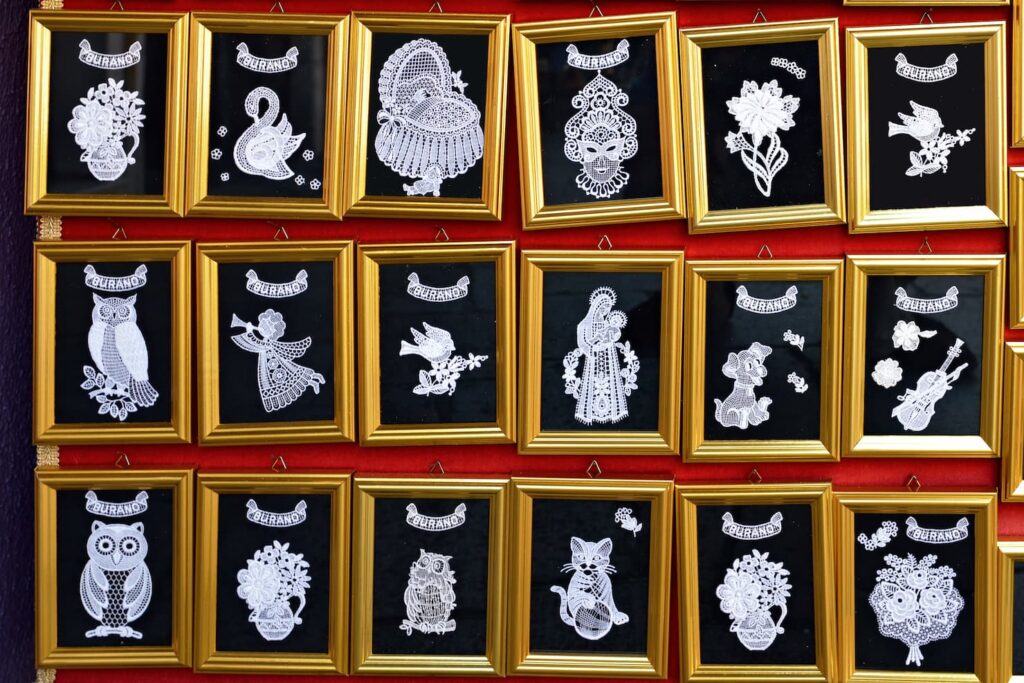
Lace typically sold as souvenirs in Burano | ID 48065853 @ Znm | Dreamstime.com
Consider that as early as the 15th century there are the first records inherent in the lace trade, and also in that period there are many books published that tell precisely about this art, as well as providing patterns and designs of embroidery.
The history of lace is not only linked to Burano, but also to the Serenissima: in fact, an important workshop arose in Venice desired by Dogaressa Morosina Morosini at the end of the 16th century, which housed more than 130 lace makers.
When she died, the workshop was closed, but production did not cease: the guild of Merciai took charge of carrying on the tradition and trade.
Thus it was that in hospices, orphanages, convents and even private homes, widespread lace production began: the role of women was fundamental in this art!
It was, in fact, females who devoted themselves to this craft with results envied all over the world: do you want to know a tidbit? When Richard III of England was crowned in 1483, the queen wore a sumptuous cloak embellished precisely with buranelli lace.
But it wasn’t just the English royals! Many of the Medici family appreciated and adorned their robes with Burano lace.
Even Louis XIV, on his coronation day, wore a unique collar from the island itself. The best lacemakers worked for a full two years before finalizing this production.
Lace, however, also had to experience a period of crisis: when the Republic of Venice was dissolved in 1797, the island’s art also slipped into disgrace.
Almost a century passed, a spark rekindled the flame: Countess Adriana Marcello tried to resume the tradition, linking the island’s economic recovery to this operation.
At the mayor’s palace, she invited the last surviving master lacemaker: the only woman who still knew all the secrets of the art.
The purpose was to have her teach everything she knew to a young master: Vincenza Memo, known as “Cencia Scapariola.” Thus, she passed the baton and buranello lace regained hope.
The new master lace-maker in turn taught other young women, also attracting orders from important European noblewomen: a true School of Lace was born.
By 1875 there were more than a hundred pupils enrolled, and piecework distributed in homes also resumed.
The school remained in operation until 1970, and in the meantime enterprises capable of carrying on the tradition and techniques sprang up.
In the building where generations of lacemakers were once trained, today the Lace Museum has been opened, an essential stop on a visit to Burano.
Lace Museum: what to see and why to visit
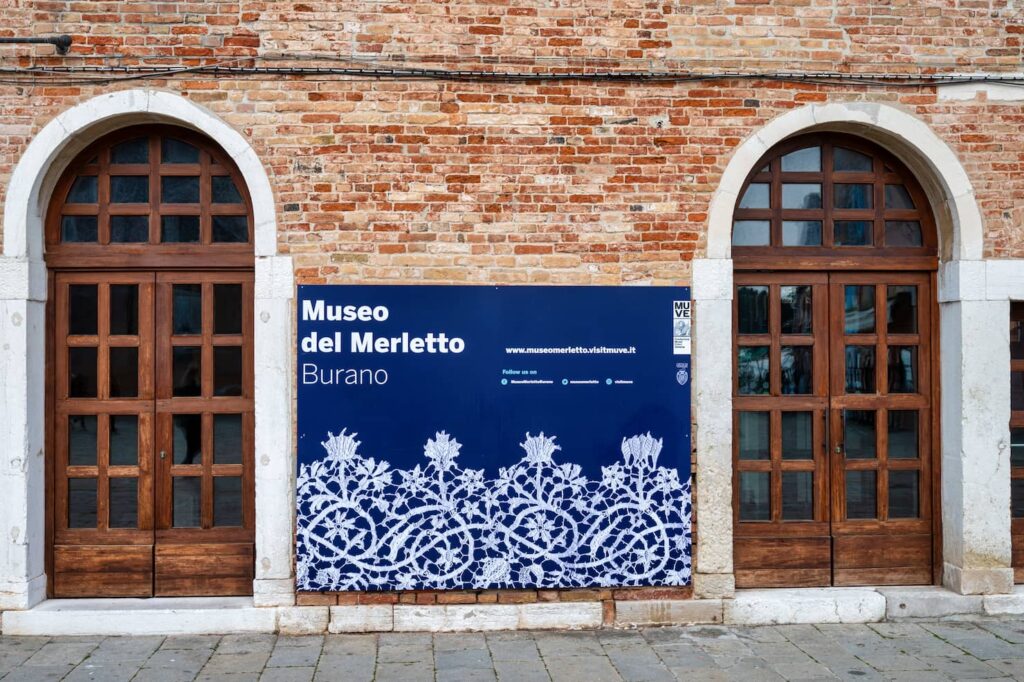
Lace Museum entrance | ID 308353820 @ Shawn Williams | Dreamstime.com
The Lace Museum is one of Burano’s main attractions and was created in 1981 thanks to a project coordinated by the public agencies of Venice in collaboration with the Adriana Marcello Foundation.
Thus, splendid historical exhibitions were organized and, above all, training courses were held with the aim of continuing to preserve and hand down the precious craft.
At the Museum you can admire a collection of more than two hundred laces, unique and priceless specimens that tell the story of Buranello lace and the school.
The lace exhibits, in fact, date back as far as the 16th century; also admirable are various documents and works of art all pertaining to this precious craft and the peculiar techniques of the master lacemakers.
But it doesn’t end there: inside the museum today it is possible to observe master lacemakers at work and also to purchase really valuable authentic works correlated with a certificate of authenticity.
The museum is located at Piazza Baldassarre Galuppi, 187, and is open every day except Mondays. From Tuesday to Thursday the hours observed are from 10 a.m. to 4 p.m. while on Friday and Saturday it remains open until 5 p.m.
Attention The museum’s closing operations begin about 20 minutes before the indicated time, so you will be able to enter no more than half an hour before the end.
Buy your admission ticket online to ensure benefits and the chance to skip the possible queue at the ticket office; you can also reserve a discounted package that also includes admission to the Murano Glass Museum.
Lace Museum: Entrance Ticket
Discover the history and art of Venetian lace
Secure payment
Instant confirmation
Mobile ticket
Where to buy authentic lace in Burano

Lace store in Burano | ID 114110851 @ Tatjanaanikeeva2011 | Dreamstime.com
Laces are truly preciousworks of art and buying one is more than just buying a souvenir!
You can choose the one that suits you at the lace museum, but that’s not all: there are many quaint little stores where you can find unique pieces.
Below is a list of the most popular stores that boast extensive collections:
- Dalla Lidia Merletti d’Arte: high quality and entirely handmade products in a historic store. In fact, techniques have been handed down from generation to generation: the owner’s great-grandmother had a prized school in Burano since 1930! Located on Via Baldassarre Galuppi, this little store also boasts its own little museum.
- Olga’s Lace: located right on Piazza Baldassarre Galuppi is another historic store where you’ll find lace makers at work able to explain tricks and techniques of their work. Fine artifacts, just a stone’s throw from the museum entrance.
- Campanil lab: a quaint little store where the kindness of the staff is truly unique! Exposed prices and care to the customer/visitor: the passion for the island’s art is the key to this place, so much so that you can receive valuable stories and curiosities related to lace and its history. The products are of excellent quality and strictly handmade.
The price, of course, depends on the size of the lace purchased, and it should be kept in mind that these are very high quality and luxury products.
That is why, one hardly goes below 100 euros for an original product. Prices exceed thousands of euros in the case of large tablecloths or particularly elaborate artifacts.
However, some more modern companies have studied new techniques capable of reducing costs and, consequently, the price although the quality of the final product suffers.
Warning It is good to recognize fakes from originals: to do so, you need to look carefully at some details. The marks of an original lace are the excellent finish and the type of thread used.
An authentic lace is carefully made and perfect in every detail with defined patterns and excellently even meshes.
The edges are also always well finished with perfectly set threads, and are often embellished with embroidery that is excellently integrated into the lace.
As for the thread, it must be strictly cotton, linen or silk and always of high quality, characterized by uniform color and smooth texture.
Finally, quality products often have distinctive marks such as a signature or are issued with certificates of authenticity.
Frequently asked questions
There are two different legends related to Burano lace, but both speak of love. The first tells of a young man tempted by the Sirens, but who was able to resist for the love of his bride: the Queen of the Sirens, struck by the young man’s soul, donated a veil woven with sea foam. The girl’s friends, therefore, tried to imitate that veil, thus creating the art of lace-making. The second legend, on the other hand, tells of a fisherman who gave his beloved a beautiful sea flower before leaving for war. The young woman decided to weave a net as a token of love, and the result was highly prized: the net had a very fine texture, just like the flower.
Along almost every canal you will find Burano’s famous colorful houses. It is really a historical characteristic of the island to have so many colors. For example you can find them in Fondamenta S. Mauro or in Fondamenta degli Assassini.
Burano lace is also known as buranello lace.
Burano is famous for its characteristic colorful little houses right above the canals, which provide striking and romantic color effects. The island, however, is also known for its art: lace craftsmanship.
Conclusions
This concludes this article on the history of Buranello lace. I have told you its history and the legends about its birth before explaining what you can find at the lace museum and giving you some useful information.
I explained how to recognize an authentic lace from a fake one and pointed you to some fine and unique little stores where you can buy your lace.
Finally, I have answered the most common questions inherent in this topic. Do you already have Burano lace in your home? Tell us yours!
Lace is an important and indispensable cultural value for the history of Burano: don’t miss a unique opportunity to see with your own eyes one of the most prestigious Italian handicrafts!
Lace Museum: Entrance Ticket
Discover the history and art of Venetian lace
Secure payment
Instant confirmation
Mobile ticket
